If you have been paying any attention to lobsters over the last few months you will know that the price has been high. Live lobsters have been up over $12 per pound and lobster meat has risen as high as $75 per pound. Yikes!
But today I bear good news. The price of lobsters has begun to drop and as the weather improves we should continue to see price decreases. Yay!
Today I updated our website, slashing small lobsters by $2 per pound and dropping a $1 per pound off from mediums, larges, and jumbos. Picked lobster meat saw a $10 per pound drop.
Mother's Day Shipping Schedule
The price drop comes just in time for Mother's Day. Mother's Day is important for us, lobsters are a popular choice to show Mom you care plus it marks the beginning of our "summer" busy season.
Mother's Day is Sunday May 10, 2015. You have two options for scheduling the delivery of tasty lobsters to your mom for a special weekend.
1. Place your order NLT 8 pm EST on Wednesday. We will ship on Thursday and your mom will receive her package on Friday.
2. Place your order NLT 8 pm EST on Thursday (selecting Priority Overnight and Saturday Delivery). We will ship on Friday and your mom will receive her package on Saturday. Please keep in mind that there is a $20 surcharge Saturday deliveries.
Trek Across Maine Fundraising
Finally, David and I will be riding in the Trek Across Maine this year. It is a 3-day, 180 mile bike ride from the western mountains (Sunday River Ski Resort) to the coast (Belfast). Proceeds support the American Lung Association of New England. If you didn't know, the ALA does a lot more than fight cancer. They also fight for clean and healthy air for everyone. They lobby for stronger emissions laws and help protect existing laws. Two of my favorite acts they supported were banning indoor smoking and smoking near public entrances.
Anyway, David and I will be riding in the Trek and working on collecting donations. If you donate $25 or more I will waive my portion of the handling charge ($10) on your next shipping order.
Step 1. Click HERE and donate at least $25.
Step 2. Send me an email at gurnetlobsters@gmail.com, I will send you a coupon code that will be good for 1 year.
Step 3. Go to shopping at GurnetTrading.Com/Shop and enter your code at check out to receive $10 off.
Oh and donations are also tax deductible. Donations need to be made by May 13th.
Oysters have long been considered an aphrodisiac, as far back as the ancient Greeks. Today, most people are quick to laugh at the though of sexual enhancement from an ocean critter, but back in 2005 there was a study done that shows there might be some truth to the old wives' tale after all. As it turns out they have zinc and some amino acids which are important to the production of testosterone in men and progesterone in women.
While there does seem to be some credence to oysters as a libido booster, does it really matter whether their effect is physiological or psychological? Either way oysters make a great alternative to the usual (read boring) Valentine's Day gifts.
Flowers wilt and chocolate is the norm. A romantic seafood dinner, on the other hand, says special. This Valentine's Day treat your sweetheart to something unique.
Valentine's Day is on Saturday, February 14th. If you place your order by the end of day on Wednesday we can ship on Thursday for a standard overnight delivery on Friday.
Or for those of you who like to wait until the last minute, you can place your order on Thursday for a Saturday delivery (usually arrives by noon) just in time for dinner that night.
This morning I read an interesting article in the Portland Press Herald about scallop diving in Maine. Whereas my dad is a commercial scallop diver and has been for my entire life, the article wasn't "new" to me. But it is interesting to see how outsiders choose to report on the industry and the heavy politics within it.
My dad first began diving for scallops in 1978 or 79 when he learned how to scuba dive while at Maine Maritime Academy. During his free time he would dive into the Bagaduce River to pick up scallops for friends and the occasional professor. After college he shipped out for a few years on ocean going tug boats, but when he returned to Maine in the late '80s he also returned to scallop diving. Initially it was a part time gig, but as both urchins and scallops became more lucrative it turned into a full time job.
When I was a kid, my dad sold his scallops door to door. He had a list of customers he would call up and sell them scallops by the gallon. There were a couple of bed and breakfasts and other "wholesale" buyers, but most were friends, family and neighbors. My parents would package the scallops in ziplock bags and deliver them around town.
It was my dad's scallops that really pushed my parents into opening Gurnet Trading Co. They were tired of driving around town and dealing with finicky wholesale markets. The opening of a seafood market meant that they could have a stable market where customers would come to them.
My dad's story mirrors the one told by Mary Pols in her article. It is a dwindling community where almost everyone knows each other. In fact, two of the divers interviewed are well known to my family. Both divers sold urchin's to my parents when they were urchin dealers and Brian Preney did many of the renovations on my brother's store, Zach's Country Store. Both Brian and my dad have served on the Scallop Advisory Council and have been active members in pushing for smarter industry regulations and protections.
For the most part the article does a decent job illustrating the scallop industry in Maine, but there are a few points I would like to expand upon.
1. Several times in the article, there is reference to a dragger's net. With this, I take great issue. What do you think of when you hear net? Personally, I envision some sort of nylon mesh. Maybe something like this net being used to catch salmon.
It is made of steel and chains. It drags along the ocean floor and pulverizes reef into dust. The author by no means implied that dragging is non-invasive but few people fully understand the "net" that scallop draggers use. This is one of the biggest reasons divers hate to be lumped in and treated the same as draggers. It would take years for a diver with a good supply of dynamite to do a fraction of the damage done by a dredge in just minutes.
2. The author mentioned that scallop divers work in 50-100 feet of water. While divers can work in those depths, it is uncommon and inefficient. Without going too far into diving physiology (trust me, I'm a scuba instructor), a commercial scallop diver sticks to depths less than 60 feet. At 100 feet, a diver can only stay down for a few minutes or else risk getting decompression sickness (aka the bends). By diving in 30-40 feet of water, a diver can safely spend hours underwater. Furthermore, at deep depths, a diver can only dive about three tanks in a 12 hour period. When he is scalloping, my dad dives about 6 tanks in a 6 hour period, far more than he would be able to do in deep water.
Diving decompression calculations further accentuate the difference between draggers and divers. A dragger can tow in virtually any depth, limited only by fuel and daylight. A diver is limited to shallow water (much shallower than many people realize) and if they do choose to dive deeper they will be exponentially decreasing their safe bottom time.
3. The following is an excerpt taken from the article.
Steneck theorized that divers might threaten the biodiversity of an area, plucking all the scallops that are particular to the Sheepscot River or Muscongus Bay. Or, if they didn’t care about the resource, by simply taking everything they see in an area. A dragger, he points out, can’t get everything; a net doesn't have a set of eyes on it. Divers laugh at this notion. They would never imperil the resource or be able to in the time their air supply or the conditions allot, they say.
I like that the author chose to follow up Steneck's position with a nod to the absurdity of this position.
First, a scallop dredge does not have eyes, therefore it scoops up or demolishes everything in its path. There is significant by-catch when dragging. Whereas scallop divers do have eyes and the bycatch is virtually not existent (though you do get a few barnacles attached to the scallop's shell and occasionally a small fish hiding out inside the shell).
Second, a scallop dredge does not have eyes, therefore it tows up undersized scallops. Yes the dredges have rings that help prevent this, but they are not perfect and undersized scallops make it to the surface. Whereas divers do have eyes, they can make an initial judgement on the size of a scallop on the bottom and leave it completely unmolested.
Third, scallop dredges don't have eyes but they do have highly accurate GPSs and advanced sounding technology. A dragger can tow back and forth, over and over for hours covering every square inch of an area. A diver is greatly limited by air, current and stamina. Generally, and diver will get in the water and do a draft dive, swimming with the current. After the sack has been filled or the diver is running low on air, he will surface. If it was a good area he might have his tender drop him back off at the beginning again, or he might move on. Diving for scallops is about collecting the low hang fruit. It is too inefficient to "clean" an area. A commercial scallop diver would never waste energy fighting currents and "chasing scallops." Divers have be able conserve enough energy to make multiple dives in a day. Kicking across the current to get that last scallop is counter productive, instead a smart diver lets the current do the work and bring him to the scallops.
Fourth, scallop dredges don't have eyes, therefore they are not limited by poor water visibility and can tow in a greater range of weather. Divers have eyes. But not really. In Maine, the water visibility is usually less than 15 feet and after rain it can drop to less than 5 feet. This winter we have had a lot of rain. That rain floods sediment into the water and shuts down visibility to a point where my dad can't dive. Even when the visibility is "good" scallop diving really is scallop hunting. You have to be practically on top of them to find them. I don't think having eyes is really an asset, scallop divers would do much better if they had antennae.
4. Another excerpt from the article
Cheney hopes the Department of Marine Resources one day will be able to re-open the licensing program. “We do have to come up with some type of re-entry plan for people,” she said. “We have a whole generation that has missed access to the fishery.”
A new plan wouldn’t necessarily favor divers, however. The divers’ work is important and low-impact, Cheney said. “But to expect the whole coastline to be harvested by divers is just not a reality.”
First, a reentry plan is critical. My dad is 56 years old. Every year for the past ten years he has said "this year is my last." The winters are too cold and the weather is too bad, especially now that he has a vacation spot in Florida. He keeps holding on though, the money is too good and he doesn't want to risk losing his license. Some fisheries allow license holders to sell their license, others allow them to be given to children. If the DMR allowed either of those things to happen, I would jump at the chance. Instead we just sit and wait as the industry shrinks and the last few old men get too tired to battle the frigid winter Atlantic.
Second, why isn't diver harvesting realistic? My dad has a lot of experience and is pretty good at scalloping but he's not Superman. He's not a Navy Seal or some crazy fish-man. He's just a guy that has made a solid living off from a class he took in college. It's not rocket science. You can get a scuba certification in less than a week for about $300. Kids only 8 years old can do it and they can get a full certification when they turn 15. The equipment isn't even that expensive, my basic cold water gear kit was less than $1500. Sure you need a boat and a tender, but you need that to drag scallops as well. The industry isn't dwindling because no one wants to do it or its too hard. If being hard kept people out of an industry you wouldn't have clam diggers or lobstermen or even doctors and rocket scientists. The industry is dwindling because they aren't letting the next generation enter the fishery. If they took the dragger permits and opened up a lottery for diver permits, it would be a tough on the draggers but I guarantee they would be able to fill the lottery with applicants, not to mention the growth we would see in regional dive shops and instructors from an influx of new commercial divers.
It just continually blows my mind, that in a era where third world countries don't allow anchors to be dropped on their reefs, we allow our fishermen to dredge the holy living hell out of ours.
If you can't tell, I'm pretty opinionated on the dragger/diver subject. I read Mary Pols' piece and wanted thank her for it and expand upon some of the topics she touched. I'll get off my soapbox now. Thanks for your time.
2014 was a busy year for us. It marked the second year of our webstore and with it came a bunch of changes to the pricing structure to help make the website more user friendly. It still needs some work but I think there were some big improvements over 2013.
After the trouble we ran into in 2013 with UPS we switched to an expediter who specializes in insuring perishable products (PERISHIP) using the FEDEX shipping network. 100% of our orders shipped during Christmas and New Years delivered on time and in good condition. This was a huge improvement over last year, which saved us and you a lot of stress and money.
Personally, I had a lot of lessons learned on improving communication with customers, especially before and during our big holiday shipping weeks. In 2013, we had a lot of last minute Christmas orders being placed the day before or the day of shipment, which makes an already hectic time of year even more crazy. In 2014, early communication and an improved scheduling system resulted in many of our orders coming in days or even weeks in advance. Yes, we still had last minute orders but overall it was a calmer season despite more shipping more orders.
In 2015 we will continue to work hard to provide the same great in-store service you are used to and continue to improve our online and shipping services. To thank you for a great year and to celebrate a great year to come, we are offering $20 off your next shipping order.
This holiday season is our busiest time of year when it comes to our shipping business. Seafood makes a great gift especially for those transplants who can't make it home to Maine for Christmas. It is also a popular choice to create a special Christmas Eve or Christmas dinner.
No surprise, it is also FEDEX's busiest season and with the extra workload and the possibility of winter storms there are sometimes delivery hiccups.
So to help facilitate the successful delivery of your packages and the creation of a memorable holiday, I have a few tips for you.
If you are sending seafood as a gift, make sure the recipient is expecting it. Lobsters are a great gift but a terrible surprise. If the recipient is away for a few days when the box is delivered they might be returning to an unpleasant gift on their doorstep.
FEDEX does NOT deliver on December 25th or on January 1st. We are NOT open on December 25th or January 1st.
The last delivery before Christmas will be December 24th. The first delivery after Christmas will be December 30th (or December 27th with a Saturday delivery).
The last delivery before New Year's will be December 31st. The first delivery after New Year's will be January 6th (or January 3rd with a Saturday delivery).
We ARE open Christmas Eve and New Years Eve, we will be closing at 5 pm.
Standard Overnight typically delivers around 4 pm but sometimes as late as 8 pm, depending on your local delivery routes. Deliveries also tend to be a little later during Christmas. If you are having a dinner party you should order Priority Overnight or even order a day early. Priority Overnight usually delivers by noon.
Live lobsters are shipped overnight and generally should be eaten shortly after arrival. However, cooked lobsters, lobster meat, scallops, chowders and other less perishable items can last a couple of extra days in transit or in a refrigerator. If you plan to ship these types of items you might consider shipping them early to create more cushion in the event of a shipping delay. For example:
You need 2 pounds of lobster meat and a pound of scallops for a Christmas eve dinner party.
If you schedule the delivery for the 23rd and for some reason FEDEX can't deliver on time, they will be able try again on the 24th. The product will still be perfect and the party will be saved.
If you schedule the delivery for the 24th and there is a problem, FEDEX will not attempt delivery again until the 26th. Uh oh hotdogs for dinner and possibly spoiled product when it does arrive.
I am not trying to scare you away from shipping. I am just making you aware that FEDEX is a third party and there are sometimes complications outside of yours or my control, but there are ways we can mitigate risk simply by choosing a different delivery day.
In the event of a mishandled box or a delayed shipment you are protected. We can submit refund claims for late deliveries or spoiled product. But FEDEX usually rejects weather related claims. So if you know there is going to be a wicked snow storm in your area we should probably reschedule the order. We do our best to watch the weather, but you are a lot more familiar with your local forecast . . . so help us help you and send me an email at gurnetlobsters@gmail.com if you are concerned about the weather.
I'm a pretty awesome person, but alas I am only one pretty awesome person. I do not have a team of pickers and packers standing by to process and ship your order. I receive the order from the website, create a shipping label, process payments, answer any questions, and then send instructions to our packer (who is also the commercial wharf hand). It's all quite manual and while not particularly complicated, it does take time. Generally, if I haven't created a shipping label by noon we won't be able to make our 3 pm FEDEX pickup. Long story short, same day shipments are really tough. Please place your order at least the day before it needs to ship. The sooner you order, the better. An early order means more time for us to plan and pick out the best product we can for your delivery.
FEDEX has announced a rate increase of about 5% for 2015. Our shipping calculator will not include this rate increase until January 1. Any orders placed prior to January 1 that are scheduled to ship after January 1 may be subject to a slight surcharge to account for the increase. We apologize for the inconvenience.
By keeping these few tips in mind we should be able to get you some tasty seafood for the holidays.
Winter is pretty much here which means Soper Ocean Services is on winter break, which is good since we ship most of our orders during the holidays.
With the extra spare time I have in the winter, I took up knitting last year. Naturally, my projects tend to have a nautical flair to them.
This year I can win a gift card from Halcyon Yarn in Bath and help fund my habit by posting a link to my wishlist. So here's wishin'. Maybe my next project will be a lobby.
If you're up on your Maine seafood news you will already know that there will be no shrimp season again this year. As sad as that makes me, at least I have some good news. There is a scallop season and it starts this week!
My dad's diving season starts on Wednesday, December 3. For the first three weeks of the season he will be allowed to dive Wednesdays, Thursdays and Fridays. Later in the season the days are earlier in the week (I will update you in a few weeks).
Why do you care what day he is diving? Because if you stop into the store in the late afternoon on a dive day you will be in line to get the freshest scallops possible. Or if you want to have some fresh scallops shipped, you will want to plan the ship day to match up with a dive day or the day after.
In preparation for the coming season, I have compiled some lovely scallop pictures and videos:
A nice stuffed turkey is very traditional. But where is the fun in traditional? Seafood is a great way to mix it up and take Thanksgiving beyond the usual trimmings.
The Fish King is a hardcore traditionalist. He squeals and throws a fit if we do anything other than a traditional turkey for Thanksgiving. We all find this especially amusing because he doesn't even really like poultry all that much; try to feed him chicken or turkey the rest of the year and he will scrunch up his nose and "suffer through." There is just something about Thanksgiving.
But that doesn't stop us from mixing it up every couple of years. Sometimes it is subtle, just a little seafood stuffing in the bird. One year we fried a turkey. Other years we have skipped the bird altogether and stuffed the lobsters.
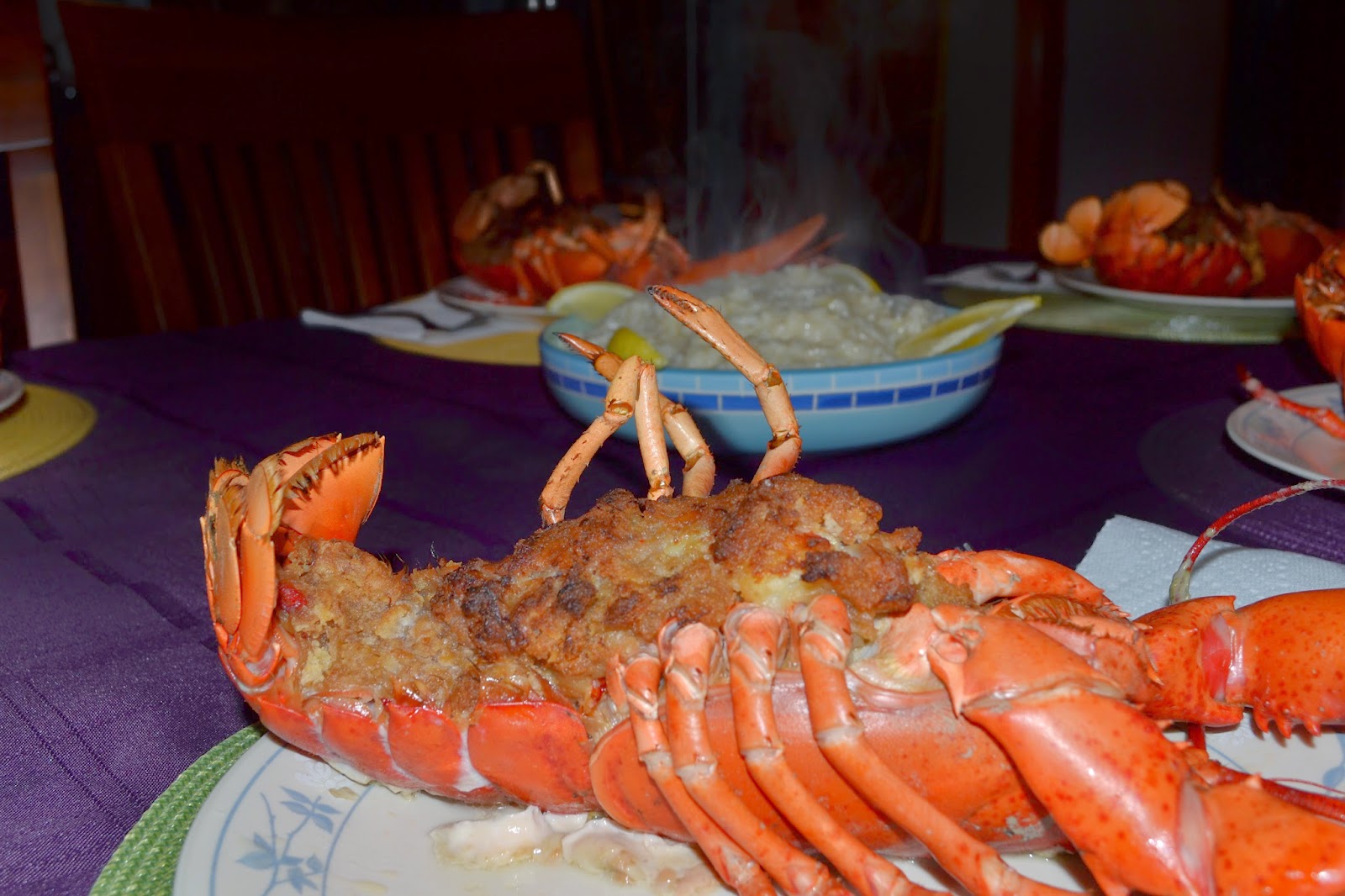
Last year we did baked stuffed lobsters with a lemon risotto. It was definitely not your traditional Thanksgiving dinner, but we had a small group and things were a little hectic so a shift from the usual spread was a welcome change. Even though we skipped the bird and the dozen or so accompaniments that usual grace the table, it was no less of a feast.
Mixing up Thanksgiving dinner is a great way to build memories and keep track of the years. If nothing else it makes for a strong bookmark in the story of family gatherings.
"Remember the year cousin Jimmy broke his toe?"
"Was that the year we had turkey?"
"No, it was the other year we had turkey."
"..."
VS
"Remember the year cousin Jimmy got peas stuck in his nose?
"Yeah! That was the year we had stuffed lobsters!"
Any lobster can be stuffed, but it is extra special when you serve a plate piled high with a jumbo lobster. We currently have jumbo lobsters on our website that range in size from 1.75 to 2.5 lbs each. Jumbo Lobsters
We have also added our seafood stuffing (which contains scallops and shrimp) to the website. The seafood stuffing is great for stuffing clams, oysters, fish, lobsters, and mushrooms. Seafood Stuffing
Buying Seafood for Thanksgiving
Gurnet Trading Co. is currently open 9-6 Monday through Saturday. We close at 5 on Sundays. We will not be open on Thanksgiving, so pick up all your supplies on Wednesday.
If you want to have some seafood shipped, all orders must be placed by Monday, November 24th. We will ship orders on the 25th for delivery on the 26th. FEDEX does not deliver on Thanksgiving.
Happy Thanksgiving! And keep your eyes peeled for some up coming holiday specials.
I, for one, am sad to see summer over. The end of summer means the steady approach of my most dreaded month, November. I mean seriously, doesn't everyone just love 30 degree temperatures and rain. But one upside to the end of summer is the beginning of oyster season.
Yesterday, I received a comment from a customer and I decided it would make a good topic for a post.
Today, I stopped into the store with plans to buy lobsters and have them shipped. I was disappointed when I was told that they couldn't process my order in the store and that I needed to go to the website instead.
This is an issue with which we have struggled. Gurnet Trading Co. has been shipping lobsters pretty much since we first opened, more than 10 years ago. It has not been a huge part of our business, a few shipments here and there with an increase in volume around the holidays.
Before we moved the shipping online it was a convoluted process. We would have to haul out a thick book of shipping tables and matrices. Using the estimated shipping weight and the ship to zip code we would figure out a base shipping rate and then make sure all the applicable surcharges were added and applied correctly. The process would routinely take more than 30 minutes to fill out all the appropriate paperwork and get an accurate shipping estimate.
Many of our cashiers (particularly in the summer) are high school and college students working during their vacations. Given the complicated and expensive nature of shipping it has not made sense to train seasonal and temporary employees how to process a shipping order. Shipping has therefore been handled by three people; our owner and our two most seasoned team leaders. As Gurnet Trading has grown, our owner has spent less time in the store and more time directing operations from behind the scenes. With so few people available and capable of processing a shipping order, it was a matter of luck as to whether or not there would be someone in the store to help you place an order.
To add to an already difficult process, the store has limited spaced and can be very busy place. It is not uncommon to have a line of customers stretching to the door. Within that line there will be people who want to buy lobsters out of the lobster tank, there will be people who want haddock out of the fish case, there will be people who want a fried clam dinner, and there might be someone who wants to ship lobsters. Often we would have to ask the customer with a shipping request to wait until we had helped the other customers with their faster and easier orders. Selling fresh seafood and cooked products is our primary and business and we have always prioritized service to those customers. A customer wanting to order a five minute lobster roll shouldn't have to wait 30 minutes to order because of a shipping order.
In recent years, business has grown so much and the store has become so busy that processing a shipping order became a huge interference to our primary business. We reached a breaking point where we considered ending shipping all together. In order to continue providing the service of shipping, when I quit my 9-5 job in 2013 to take over Soper Ocean Services we decided that I would also develop a web-store and move our shipping process online.
Today, I manage the web-store; answer online inquiries and process all shipping orders. There have been some definite pros and cons to my taking over the shipping and moving the process to the internet.
PROS
I am off-site so I am not eating up valuable real estate in the store.
I am a single point of contact to provide unified and consistent responses.
I am off-site so I don't get caught up and distracted by the hubbub of the store.
Working from home allows me to respond to customer inquiries outside of normal business hours.
I have low overhead costs. I am only paid for my time spend working on the website or interacting with customers. An in-store shipping manager would have to be paid full time and work regular hours in the store, regardless of whether or not there were any shipments.
Being online, the shipping estimator is fast and accurate.
Being online a customer can place an order anytime of day.
CONS
Being off-site means that the website does not always have the most up to date pricing or status. There is usually lag between price changes and specials.
Being off-site also means that I am not available in-person to help customers.
My day job has me working on a mud covered barge from April to November. While I can answer general questions from the wheelhouse on my barge, I can't process an order. Our customer's have to wait until I get off the barge in the afternoon for more complicated answers and quotes.
Having a website moves more of the responsibilities and effort onto the customers. Which means if they are having trouble or have questions they have to make an additional effort to contact me.
ADDRESSING THE OFFSITE CONS
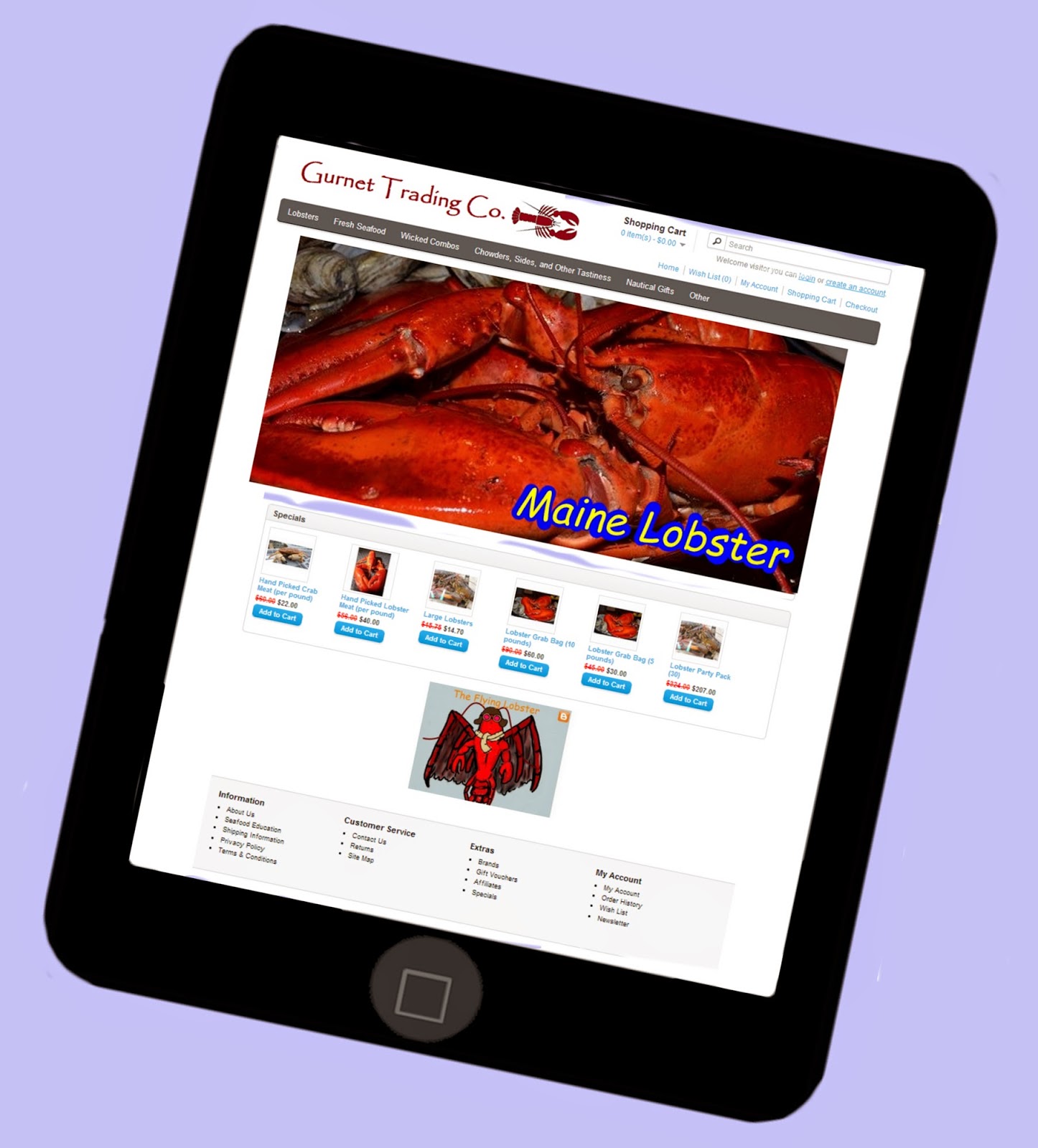
If you come into the store and want to place a shipping order, we have an IPAD set up that is linked to our website. Our team members can help walk you through the process. I also try to keep a stack of my business cards next to the IPAD, to encourage people to contact me. While my business cards only have the web address and my email address (gurnetlobsters@gmail.com) on them, the store will also give out my personal phone number for those who do not have computer access or need additional help.
I always make an effort to answer emails or respond to voice mails within a few hours or at least by the end of the day. I can usually respond to emails faster than voice mail, because of cellphone reception problems on the water.
It's certainly not perfect and we do have some problems, but in the end we work hard to take care of you and provide the best service we can. We are always open to recommendations and always want to hear about any troubles you have had with our service.
HELP US HELP YOU
Here are a few tips to help us improve our service:
Be specific with your comments. The more detailed and specific you are the more we can do to improve future experiences.
Who? Was there a specific employee who provided good service? One who provided poor service? Or was unable to help you? Did the team member seem knowledgeable?
What? What happened? Be specific. Did the website produce an error code? Were instructions confusing? Did you have problems during checkout? Did you have trouble navigating the site?
When? What was the date and time of the event you wish to comment on?
Shipping is expensive, especially when you are talking about shipping a live or perishable product. Shipping is at its most expensive when you are shipping Standard or Priority Overnight. If not the most expensive part of the order, shipping will usually be at least as expensive as the product being shipped. Today, I' m going provide a few tips to help reduce that ratio and make the the most of your order.
Weight vs. Volume
Shipping is calculated using two measures, weight and volume. The shippers (FEDEX and UPS) set a minimum ship weight that is based on the size box that is shipped. You want to avoid orders that are lighter than the minimum ship weight, you will just end up paying for unused weight.
Generally speaking we have three different size boxes we use to ship. Large lobsters do not fit in our small box. We can ship up to 6 large lobsters in our medium box. when we use a medium box, the minimum weight that we get charged for is 10 pounds.
This example illustrates how shipping at least the minimum weight reduces the shipping cost per lobster.
Fixed vs Variable Costs
Some of your shipping charges are variable. That is, as your weight increases so does your cost. Or in the case of insurance, as your value increases so does your insurance. But some of your costs are fixed. The best example is Gurnet Trading's handling fee. It is a flat $30 per order. This charge covers the expense of the box, the gel packs, my labor to process your order, and the labor to pack the box. To minimize the impact of fixed charges, order more product.
This example illustrates how ordering enough items can make the $30 handling fee almost inconsequential.
High Value vs Low Value
When you place an order you want to get the biggest bang for your buck. You want to spend your money on the product not the shipping. You can't eat shipping. Shipping doesn't taste good. You can't even put in on a shelf to display. So the best way to reduce the impact of shipping, is by ordering high value items.
This example illustrates how shipping a high value item like lobster meat reduces the effect of shipping charges on the overall price. Shipping 5 pounds of crab claws and 5 pounds of lobster meat costs pretty much the same (the lobster meat needs an $3 in insurance), but shipping makes up 85% of the crab claw order while it only makes up 30% of the lobster meat order.
This examples isn't to tell you not to ship low dollar items. We want to sell crab claws and clams as much as we want to sell lobsters and chowders. But you can make the most of your order by mixing and matching high and low value items to maximize your YUMMY:SHIPPING ratio while still ordering your favorite products.
Economics vs Enjoyment
Seafood is not just food. Often it is an event. You sit around a table with friends and family picking apart food and eating in a more primal and tribal way. This is especially the case with live lobsters. There is the thrill of cooking a live creature yourself. There is a satisfaction in knowing how it was handled and treated. When intangibles like satisfaction and enjoyment enter the equation, economics get thrown out the window. It is hard to put a price on the smile of a child holding their first live lobster. What is the worth of the rowdy laughter of a family watching a puppy bark at lobster crawling across the floor?
When you aren't looking for an event, the economics are easy to calculate. Certain items are more efficient to ship. Live lobsters vs lobster meat is the single best example of how intended use of a product can drive cost.
This example illustrates the difference intended use can have. It takes about 7 pounds of live lobsters (or about 5-6 small lobsters) to make 1 pound of clear meat. Clear meat packs much smaller and lighter than live lobsters. When you ship live lobsters you are paying for the weight of shells, organs, and water. 2 pounds of meat can go into a small box while 11 lobsters has to go into a medium or large box. From an economic standpoint, we should only ever ship lobster meat. But where is the fun in that? No one wants to go to a lobster bake and eat picked meat out of a bowl. They want to crack the shell open and suck the legs. Some people want to hunt for tomalley and row. Others want to trade their tales for claws.
The Tips
Obviously your order is going to be based on your preferences, needs, and budget. But when you can, think about these tips to help reduce your shipping cost.
Beat the dimensional weight minimum by ordering dense items that pack tightly into small boxes such as scallops, lobster meat, clams, mussels, and oysters.
Reduce the impact of flat rate handling charges ordering more products.
Mix high value items with low value items to reduce the impact of shipping.
Consider your purpose. Is there a specific reason you need the product alive and in the shell? A processed product might ship cheaper.
Do you have friends, family, neighbors or co-workers who might want to order as well? Get together and place a single order for the holidays or special event. We can put up to 50 pounds of product in a single box. A 50 pound order will have great economy of scale. On shipping alone, you will save, but we might also be able to discount product prices as well.
This week I have been working on tweaking the web-store to hopefully make it more user friendly and flexible.
- Lobsters no longer have to be purchased in a pre-determined box size. You may select as many or as few as you want.
- There is now an option to choose between live and cooked lobsters.
- The number of lobster product links have been trimmed, now all you have to do is choose between Small, Medium, and Large
- The upfront product price will now better reflect the prices posted in the brick and mortar store. Packaging expenses have been moved to a flat handling charge that is applied at checkout.
- For the time being we have removed the combination packs (except for the Lobster Roll Kit). Some of them will be returning. Right now, our products are available a la carte.
Also, new this week, I got motivated and sent out an email newsletter/flyer. I have been collecting email addresses for months, I just hadn't gotten around to publishing anything yet. My goal is to send one out once a week with updates and specials. So if you haven't already joined our mailing list you can do so here.
As winter approaches lobsters head offshore for warmer water. Wait . . . what did you say? Warmer water offshore? Yep. That's right, the shallow coastal waters are much more susceptible to seasonal temperatures changes. Large bodies of water (i.e. the deep ocean) maintains a relatively stable temperature year round while the coves and creeks near shore can actually freeze over.
When the lobsters move offshore for the winter, only some fishermen follow them. It takes a bigger boat and more gear to travel greater distances and be able to work in the rougher weather. In the winter, many fishermen will use the winter to dry out their gear and perform maintenance on their boats. They might switch to digging clams or join a construction crew. At one point we had a fishermen who was a real estate agent in the winter.
The winter also brings bad storms and rough weather that keep the boats at the dock.
Harder to Catch Lobsters + Fewer Fishermen + Fewer Fishable Days = Fewer Lobsters Caught and Higher Prices
The deep winter usually yields extremely high prices. We were up to $9 per pound for live lobsters in the store in April. But I have good news. We are now on the backside of the hill. The near shore waters are starting to fill up with lobster buoys, the lobsters are moving towards the warming coastal waters to shed their shells and breed. The weather is improving and catches are up, meaning the prices of lobsters is beginning to drop.
Being in the seafood business, my family tends to send boxes full of seafood treats to our extended family members outside of Maine for the holidays. My aunt and uncle in Texas get box, as well as my grandparents in Florida. It makes Christmas shopping a whole lot easier. For a seafood lover, lobsters and scallops are way better then a gift card or some awkward gift that is just going to get returned anyway.
With David and me at his parent's house in southern Florida for Christmas this year, we too had a box shipped down. Every year on Christmas Eve, all of his extended family shows up for a big dinner on and I wanted to use the opportunity to show off some real Maine seafood.
Who heard about the massive UPS shipping failure? Maybe you even experienced some shipping problems yourself? Well, as Gurnet Trading's shipping manager, I spent all day on the 24th tracking down boxes we had shipped both for customers and our family members. By noon, I had received delivery exception notices on 50% of my shipments. I was frantic. In 10 years of shipping our products, we had never experienced a mass failure like this. I spent hours on the phone coordinating between regional distribution centers and recipients. By the end of the day, all but three boxes had delivered. The good news was that one of those three boxes was my own and I would not have to worry about an upset customer or refund. The bad news was that I had a box filled with live oysters and temperature sensitive products sitting in a non-climate controlled tractor trailer container in Orlando Florida. If a box of seafood is going to get stuck someplace, you pray that it is Colorado or Michigan; not Arizona, not Florida. All three of my stuck boxes were in Florida.
So Christmas Eve came and went without our seafood appetizers. Christmas Day came and went with thoughts of my four pounds of diver scallops sitting on a truck in Orlando niggling at the back of my mind. On December 26th I was up early, checking the tracking statuses on my remaining three boxes.
One box delivered with 10 pounds of dead lobsters. At least my customer had a sense of humor about it. This order has since been redelivered at no cost to my customer.
Another box delivered with 6 dead lobsters, 6 live lobsters, and 10 pounds of live clams. A full credit has been offered to make up for the late delivery and the dead lobsters.
And what about my box? Well, when it arrived the gel packs were still partially frozen. A good sign. We seal our Belon oysters with lobster bands so they retain their moisture; they were fine. We started sticking thermometers in everything and we found that all of the products were registering about 40 degrees. More good news. I did a quick sniff and taste test and happily declared everything good to go.
We had good news, all of our seafood had survived the disastrous four day trip from Maine to Florida. But we also had a bit of a problem: we had enough seafood for 20 people and only 9 people to eat it.
Step 1: Freeze 2 pounds of scallops. My dad had harvested them the day they shipped out, so a scallop frozen within 4 days of being caught would stay good in the freezer for up to a year (not that they would last that long in my Father-In-Law's freezer.
Step 2: Cook and eat everything else in an all day seafood fest.
The biggest oyster eaters, shucked them and ate them raw with cocktail sauce.
Wild Belon Oyster, raw on the half-shell.
The rest of the oysters were stuffed and baked.
Baked Stuffed Belon Oysters
Mike, my sister-in-law's boyfriend, getting ready to dig into a Belon oyster.
Baked Stuffed Oyster Recipe
Set grill to high heat. Cook oysters until they "pop" open. Remove from grill. Oysters will still be mostly raw, but are much easier to work with.
Remove and discard the top shell. Scrape the oyster meat free of bottom shell but leave it sitting in the shell.
Cover the meat and shell with stuffing (bread crumbs, melted butter, Parmesan cheese, crab meat, parsley). For 20 oysters we used 4 oz of crab meat and about 3 cups of bread crumbs.
Drizzle melted butter and squeeze a little fresh lemon on top of the stuffing.
Broil the oysters on a cookie sheet on 500 degrees for a few minutes, until the stuffing is browned. As you can see our's could have cooked a touch less, but they were still delicious and I am not even a big fan of oysters.
Half of the crab claws we ate cold, straight out of the box. The other half we reheated and ate with hot butter.
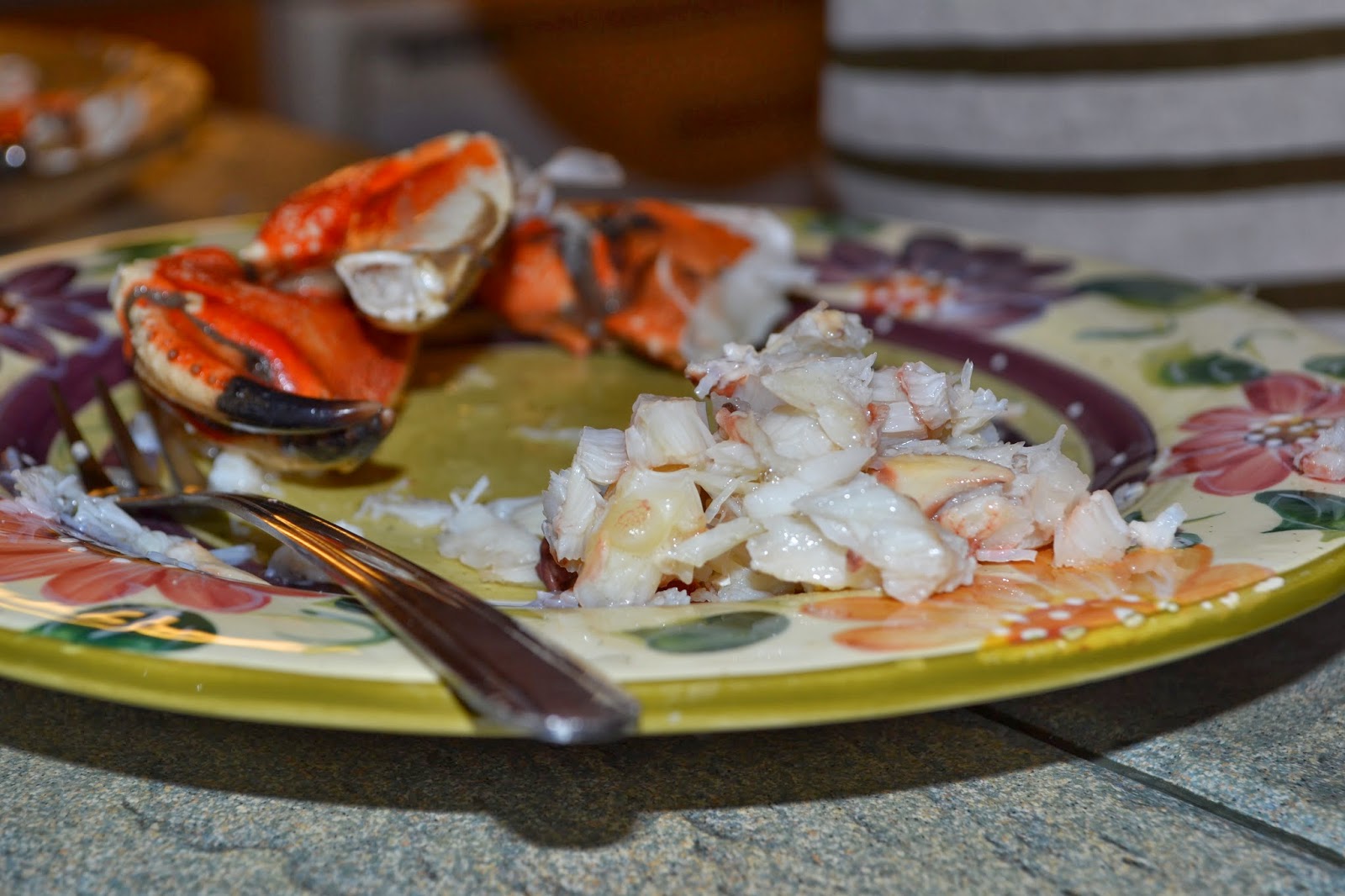
A small pile of crab meat I picked out for David's grandmother, who did not want to slurp the meat direct from the shells like the rest of us.
The scallops were seared in butter and served with lemon risotto.
Before we left Maine, we bought a pressure cooker. We had never used one but had read good things about them. We were especially interested because we would be travelling in a small camper with limited space for cookware. This quickly became our new favorite kitchen item. You can make complex multi-pot dishes in a single pot. So far we have made beet risotto, squash risotto, lemon risotto, chicken chili, beef chili, pot roast, mashed potatoes, spaghetti sauce, short ribs, country ribs, and more. What do you eat when you are on a road trip? McDonalds? Yea me too. Not this trip though. We ate homemade deliciousness. You can cook dry (un-soaked) beans in 45 minutes. A pressure cooker creates meals that normally take hours in only minutes. If you can't tell, I'm a big fan.
Anyway, this tangent has a purpose. We used our pressure cooker to make the risotto we served with the scallops.
Seared Diver Scallops with Lemon Risotto Recipe
On medium heat, saute one chopped onion in olive oil in the pressure cooker until the onion becomes translucent.
Add 2 cups of Aborio rice and toast until lightly brown.
Add a splash of white wine to un-stick the rice. Heat until the alcohol has been evaporated.
Add 4 cups of chicken broth.
Close and lock the lid. Raise the heat to high until the pot reaches pressure. Once pressure is reached, reduce heat to low and cook for 7 minutes.
After 7 minutes use quick pressure release method (run over with cold water).
Mix in 1 tablespoon of parmesan cheese, salt and pepper to taste, zest and juice of 2 lemons, and 2 cups of baby spinach.
While the rice is cooking . . .
On medium heat, sear the scallops in a butter coated frying pan or skillet. Cook each side until golden brown. Do not over cook; a scallop should be slightly raw at the very center. If you have a good product, do not worry about under cooking your scallop. While over cooking a scallop is criminal, you also want to make sure to cook it long enough to get a nice caramelization on the outside. All that being said . . . relax and have fun . . . its really hard to mess up a good scallop . . . even a poorly cooked high quality scallop is amazing.
A Few Final Comments
The seafood was a hit. My husband's family loved it and they were stunned that I know how to cook. I just laughed and said scallops and oysters don't really count. Anyone can cook seafood like a chef if they have chef grade ingredients.
When the scallops arrived, Mike informed me that he does not like scallops.
I said "Ok, maybe not. But wait until you have tried my dad's scallops before you condemn them."
Mike ate more scallops than anyone.
I was very frustrated with UPS. I still am. I am still working on processing claims to be compensated for my customer's dead lobsters. My customers pay a premium for overnight delivery, not because they are impatient or waited until the last minute to order, but because our products are highly perishable and need to travel as fast as possible in order to guarantee a live product. Yes, sometimes a box will be fine two or three days later, but that is not a risk I want to take with expensive living seafood.
My seafood sat on a truck for four days and still tasted and smelled just as good as it would have had it arrived without delay. When I go into a supermarket or restaurant and I smell or taste something fishy, it really makes me wonder where it came from and what has been done to it.